
India’s First Private University Battery Research Center
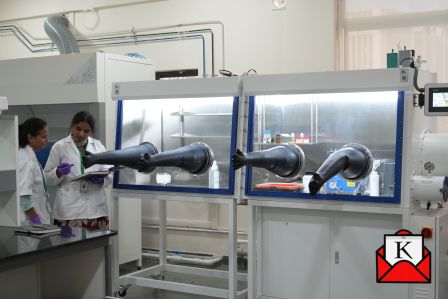
MIT-World Peace University (MIT-WPU) has opened a cutting-edge battery fabrication and research facility specializing in lithium-ion (Li-ion) and sodium-ion (Na-ion) technologies, marking a major advancement in sustainable energy solutions. This innovative project, which was started for the first time by a private state university, aims to significantly contribute to India’s energy independence and is in line with national initiatives like Atmanirbhar Bharat and Make in India.
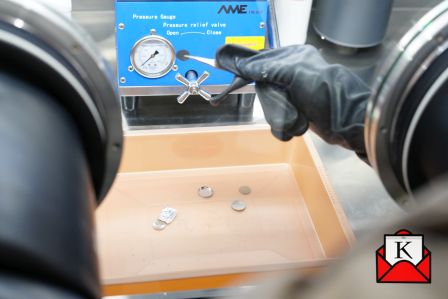
With extensive in-house capabilities ranging from active material synthesis to coin cell fabrication and electrochemical performance evaluation, the facility is built for end-to-end battery development. Advanced electrode materials are being actively developed by the MIT-WPU research team to improve important battery performance metrics like energy density, cycling stability, and operational safety. At the same time, work is being done to create next-generation solid-state electrolytes (SSEs), with an emphasis on materials that are thermally stable and have high ionic conductivity. These SSEs represent a major advancement in energy storage technology by providing safer and more effective substitutes for traditional liquid electrolytes.
Novel strategies like the creation of paper-based batteries and the application of glass-polymer composite electrolytes are also being investigated. In order to provide Indian battery manufacturers with high-quality raw materials, the facility has also started work on the synthesis of high-purity solvents and electrolytes for Li-ion batteries.
With the newest equipment and tools, the facility facilitates academic research as well as joint ventures with businesses and research organizations, assisting in the conversion of innovative concepts into scalable, practical solutions. The plant will soon be able to produce prismatic and cylindrical cells as well, increasing its capacity for a greater variety of battery uses.
The facility is dedicated to developing future talent in addition to research and innovation. In addition to providing Ph.D. scholars and researchers with exciting opportunities to pursue cutting-edge work in battery technologies, it acts as a dynamic training ground for science and engineering students.
This innovative project embodies the core goal of MIT-WPU Executive President Dr. Rahul Karad, who wants to equip MIT-WPU students with innovative skills in cutting-edge technologies so they can have a significant and prosperous career in India’s clean energy transition.
For more details, visit https://mitwpu.edu.in/
Priyanka Dutta