
PETA India’s Special Campaign On Freedom Of Birds From Cages


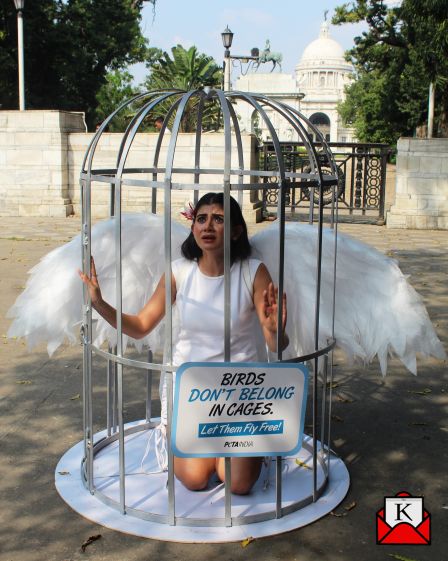
Actor and People for the Ethical Treatment of Animals India (PETA India) supporter Prantika Das defended all birds in response to the Calcutta High Court’s order prohibiting the sale of unapproved animals at Galiff Street market. She was imprisoned inside a cage in front of Victoria Memorial, near a sign that said, “Birds Don’t Belong in Cages. Let Them Fly Free” while wearing a white outfit with enormous wings. Das wants people to understand that birds belong in the skies, not in prisons, and to never purchase them.
According to Das, “Birds are designed to experience the wind in their wings, not languish in cages. Instead of imprisoning birds, PETA India and I are urging Kolkata citizens to get binoculars and observe stunning birds in their natural habitats”.
Birds of many species interact socially in the wild by dancing, playing hide-and-seek, having sand baths, constructing nests with their partners, and caring for their young. However, these same energetic creatures can become sad and reclusive when kept in small cages and denied the chance to exhibit their normal behaviors.
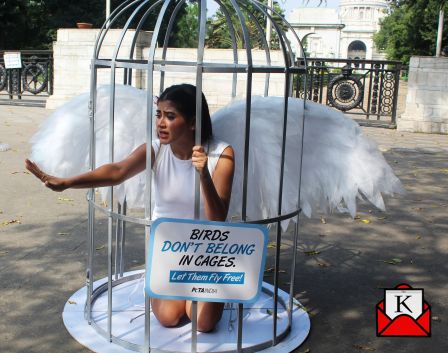
Many preen and pluck feathers excessively, frequently to the point of self-harm. Some people try to stop birds from flying away by making them endure wing clipping, although flying is just as essential and natural to birds as walking is to humans. Many birds in the bird trade suffer and perish in transportation due to injury, dehydration, malnutrition, or extreme stress after being collected from the wild, packed into tiny boxes, and transported to be sold into captivity. Those who survive lead miserable lives in cages, frequently experiencing stress, loneliness, depression, hunger, and maltreatment.
The Wildlife (Protection) Act, 1972 (WPA, 1972) limits the possession and trade of protected indigenous wild birds and forbids their capture and hunting. Violators face jail, a fine, or both. The Convention on International Trade in Endangered Species of Wild Fauna and Flora (CITES), which India integrated into the WPA with its 2022 amendment, further regulates international trade in endangered species. According to the PCA Act of 1960 and the Bharatiya Nyaya Sanhita of 2023, cutting a bird’s feathers to keep it in custody and prevent it from flying is considered mutilation and maiming.
A great initiative indeed by PETA!!
Priyanka Dutta