
Interview: Subhash Chandra Kushwaha On New Book Bhil Revolt

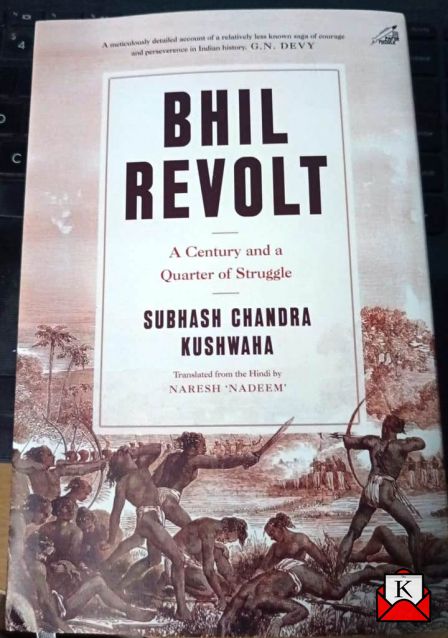
Bhil Revolt: A Century and a Quarter of Struggle is written by Subhash Chandra Kushwaha and translated from the Hindi original by Naresh Nadeem. The Kolkata Mail correspondent Priyanka Dutta caught up with the author in an exclusive conversation about the book. Excerpts..
What sparked your interest in the 125-year struggle of the Bhil tribes, and why did you feel now was the right time to bring this story to a mainstream audience?
Subhash Chandra Kushwaha– The Bhil community of Central India, which once exercised authority over nearly one-third of the Indian subcontinent, never fully surrendered its political autonomy, cultural identity, or social structure despite the gradual displacement of tribal control from the plains between the seventh and fourteenth centuries by incoming Rajput powers. Even during the period of Maratha expansion, when Bhil populations were subjected to plunder, violence, and systematic repression, they continued to resist in defense of their indigenous identity and territorial autonomy. With the arrival of the East India Company, at a time when many princely rulers accepted British supremacy, several Bhil chiefs rejected colonial interference and sustained their resistance. Their profound attachment to land, forests, and the natural world became one of the central reasons for my intellectual engagement with their history.
What was the most surprising or challenging piece of documentation you uncovered during your research?
Subhash Chandra Kushwaha- The century-long resistance of the Bhil rebels attracted my attention because it represented not merely a political struggle, but a broader defense of land, ecology, and civilizational identity. Yet, mainstream Indian historiography has largely neglected this tradition of resistance. This book identifies and reconstructs the histories of more than two hundred Bhil rebels, many of whom are being documented systematically for the first time. This raised a fundamental question: why has dominant historical writing ignored such a significant stream of indigenous resistance? I came to believe that recovering this history is essential because the struggles of indigenous communities over water, forests, and land have long been marginalized within elite-centered narratives of the past. The study also seeks to foreground the larger tension between dominant social groups and historically marginalized communities, particularly at a moment when global scholarship increasingly recognizes the need to reinterpret history from subaltern and indigenous perspectives.
History is often written by the victors. How did you navigate the biases found in colonial records to reconstruct an authentic narrative for the Bhil people?
Subhash Chandra Kushwaha– One of the greatest challenges during the course of research was uncovering historical truth embedded within colonial archives. British administrative records frequently described the Bhils as “bandits,” “disturbers,” or “savages,” yet those very documents simultaneously contained evidence of their organized resistance, military capabilities, and sophisticated social structures. Interpreting these contradictions and identifying the ideological assumptions underlying colonial discourse proved to be among the most difficult aspects of the research process.
You describe a “triad of forces”—the Rajputs, Marathas, and the British—oppressing the Bhil tribes. How did the nature of their resistance change as they moved from fighting local powers to facing the British colonial machine?
Subhash Chandra Kushwaha– History has often been written from the perspective of the victors. Although colonial records portrayed Bhil resistance as criminal or predatory, the same archives also acknowledged the courage, leadership, and political determination of figures such as Nadir Singh, Bhima Nayak, Bhagoji Nayak, and Kazi Singh. Rather than reading these records solely through a colonial lens, it was necessary to reinterpret them in relation to questions of indigenous identity and the defense of land, forests, and natural resources. For this reason, each rebellion was examined through multiple documentary sources and interpretive frameworks. Alongside colonial records, I also relied extensively on tribal songs, oral traditions, local manuscripts, regional histories, and collective indigenous memory. My objective was to present the Bhils not merely as anti-state elements, but as communities striving to defend their geography, culture, and autonomy.
The book highlights guerrilla warfare tactics. Could you elaborate on how the Bhils utilized their knowledge of the terrain to hold off superior military forces for over a century?
Subhash Chandra Kushwaha– The forms of domination exercised by Rajput rulers, Maratha powers, and the British differed significantly from one another. Bhil resistance to Rajput authority was primarily aimed at preserving political independence, rejecting external interference and taxation, and maintaining control over tribal territories. Their opposition to British rule emerged more forcefully when colonial authorities intervened in support of princely states and initiated systematic military suppression through the protection of allied rulers. In its early phases, therefore, Bhil resistance was directed largely against local feudal structures. However, once British authority became firmly established, the struggle gradually transformed into a broader anti-colonial movement tied to the liberation of land and territory. The British employed a combination of military force, legal mechanisms, and administrative surveillance, compelling the Bhils to rely increasingly on guerrilla warfare, mobile resistance, and local alliances.
How did the transition from being autonomous rulers to a marginalized community impact the collective psychology and cultural identity of the Bhil tribes?
Subhash Chandra Kushwaha– One of the greatest strengths of Bhil society was its decentralized and clan-based system of self-governance. Equally important was their intimate geographical knowledge of mountains, forests, valleys, and inaccessible terrain. Their familiarity with the landscape was so extensive that even powerful colonial armies struggled to establish complete control over them. Bhil fighters employed swift attacks, rapid dispersal, and sustained resistance through the use of local resources. This explains why their opposition endured for more than a century despite the technological superiority of modern colonial weaponry.
You feature over 200 Bhil leaders in your work. Aside from the well-known Tantya Bhil, is there one specific leader whose story you feel deserves more recognition in the national consciousness?
Subhash Chandra Kushwaha– The transformation of the Bhils from autonomous ruling communities into marginalized populations had a profound impact on their collective consciousness. It affected their social organization, economic conditions, and cultural self-confidence. Nevertheless, they succeeded in preserving significant elements of their traditions, oral memories, communal relationships, and nature-centered worldview. This continuity itself stands as evidence of their remarkable historical resilience.
Tantya Bhil is often referred to as The Great Indian Moonlighter. How did his specific brand of leadership and resistance influence the movements that followed him?
Subhash Chandra Kushwaha– Although Tantya Bhil remains comparatively well known, many other important figures—including Khajya Nayak, Bhima Nayak, Bhagosingh Nayak, Nadir Singh, Gumani, Kur Vasava, Icha Puggi, Omkar Rawat, Sitaram, Putta Ji Nayak, and Chitto Nayak—have yet to receive adequate recognition at the national level. These leaders organized local communities, challenged colonial authority, and sustained traditions of resistance over extended periods.
You argue that the Bhil struggle was not just for land but for the preservation of a unique way of life distinct from Hindu practices. Why was it important for you to highlight these cultural distinctions in a book focused on revolt?
Subhash Chandra Kushwaha– The leadership of Tantya Bhil extended beyond military resistance alone. He emerged as a symbol of trust, courage, and justice among ordinary people. His actions inspired oppressed communities with the belief that colonial power was not invincible. Over time, his image evolved into that of a popular folk hero who stood with the poor and marginalized. Similar forms of resistance consciousness can later be identified in several mass movements across India.
What do you hope contemporary readers, especially those from indigenous communities, take away from this account of their ancestors’ 125-year-long courage?
Subhash Chandra Kushwaha– I emphasized cultural distinctions because the Bhil struggle cannot be understood solely in political or economic terms. The Bhils were also defending their way of life, ecological relationships, communal traditions, and cultural autonomy. Mainstream society has often attempted to assimilate tribal communities within dominant social frameworks, overlooking the fact that these communities possessed distinct cultural identities of their own. Without recognizing this dimension, the deeper meaning of Bhil resistance cannot be fully understood.
As this work was originally written in Hindi and then translated by Naresh Nadeem, how do you feel the translation helps in reaching a broader audience interested in anti-colonial history?
Subhash Chandra Kushwaha– I hope that contemporary readers, particularly younger generations within indigenous communities, will draw from this history a sense of dignity, self-respect, and inspiration for collective struggle. This book demonstrates that the Bhils were not merely passive victims of history; rather, they consistently resisted injustice and oppression. In this sense, the work is also an attempt to restore courage, historical memory, and indigenous selfhood.
Since this book was originally written in Hindi, its translation into English was of considerable importance. The translation by Naresh Nadeem has opened the possibility of introducing this history to a wider national and international readership. It now enables readers who do not know Hindi, but who are interested in anti-colonial movements and indigenous histories, to engage meaningfully with the history of Bhil resistance.
Although certain information regarding Tantya Bhil had previously been available, this work introduces, for the first time to Indian readers, serialized accounts published in Australian newspapers in 1906, thereby bringing to light several previously unknown dimensions of his life and activities. In this respect, the book assumes particular significance, as it not only expands the historiography of tribal resistance in India but also offers new material of enduring scholarly value to both Hindi- and English-speaking readers.