
Exclusive Interview: Nirmal Kanti Bhattacharjee On The Invention Of Shoe
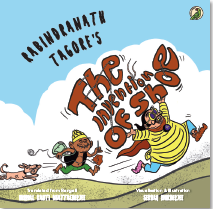
Nirmal Kanti Bhattacharjee has managed to combine his love of translation with a profession as a professor and cultural administrator. He enjoys telling stories in many languages, creating what he lovingly refers to as “word salads” that expose readers to different tastes.
The Kolkata Mail correspondent Priyanka Dutta caught up with the author about his new translation work, The Invention of Shoe, by Rabindranath Tagore. Excerpts..
How important is retelling stories for young adults?
Nirmal Kanti Bhattacharjee- The young minds of today are now crowded with mechanical video games, superheroes, and fantasy fiction. I would therefore think that the retelling of such stories, giving a fresh perspective and wings to the imagination, is very important today.
What things did you keep in mind while retelling such an important story?
Nirmal Kanti Bhattacharjee- Ranindranth Tasgore is one of the greatest lyricists in the world. Even his children’s stories are full of metaphors, similes, and allegories. So in retelling the story of The Invention of Shoe, I had to keep this constantly in mind and invest in the language which would best approximate the style of the original narrative.
Did you face any challenges while retelling a story by Tagore?
Nirmal Kanti Bhattacharjee- There were several challenges when I sat down to retell this story. First, it was written in rhyming couplets. I figured out that if I tried to produce rhymes in English, I would have to sacrifice a lot of the nuances of the original. Hence, I decided to do it in free words. Secondly, certain allusions are very native to Bengali, like the use of Nassi, which is an addictive tobacco taken through the nostrils. Today’s younger generation will not be able to understand it. So instead of nine drums of Nassi, I used 100 liters of coffee.
How vital is illustration for a story for young readers?
Nirmal Kanti Bhattacharjee- The young readers like to visualise things when they read a story. Hence, illustration is extremely important. I personally think that my translation has been highly enhanced by the wonderful illustration done by the artist.
Do you think young readers will be more inclined to read when they can get such stories in English?
Nirmal Kanti Bhattacharjee- Of course, they will. When a story is written in a particular language, it remains confined to the speakers of that language only. But when it is considered in English, it is likely to have a pan-Indian, even an international platform. Hence, a larger number of young readers will be inclined to read it.
What will be your next book on?
Nirmal Kanti Bhattacharjee- Presently, I am involved in a major translation work for adults assigned by the Sahitya Academy, hence I cannot think of my next children till next year.